


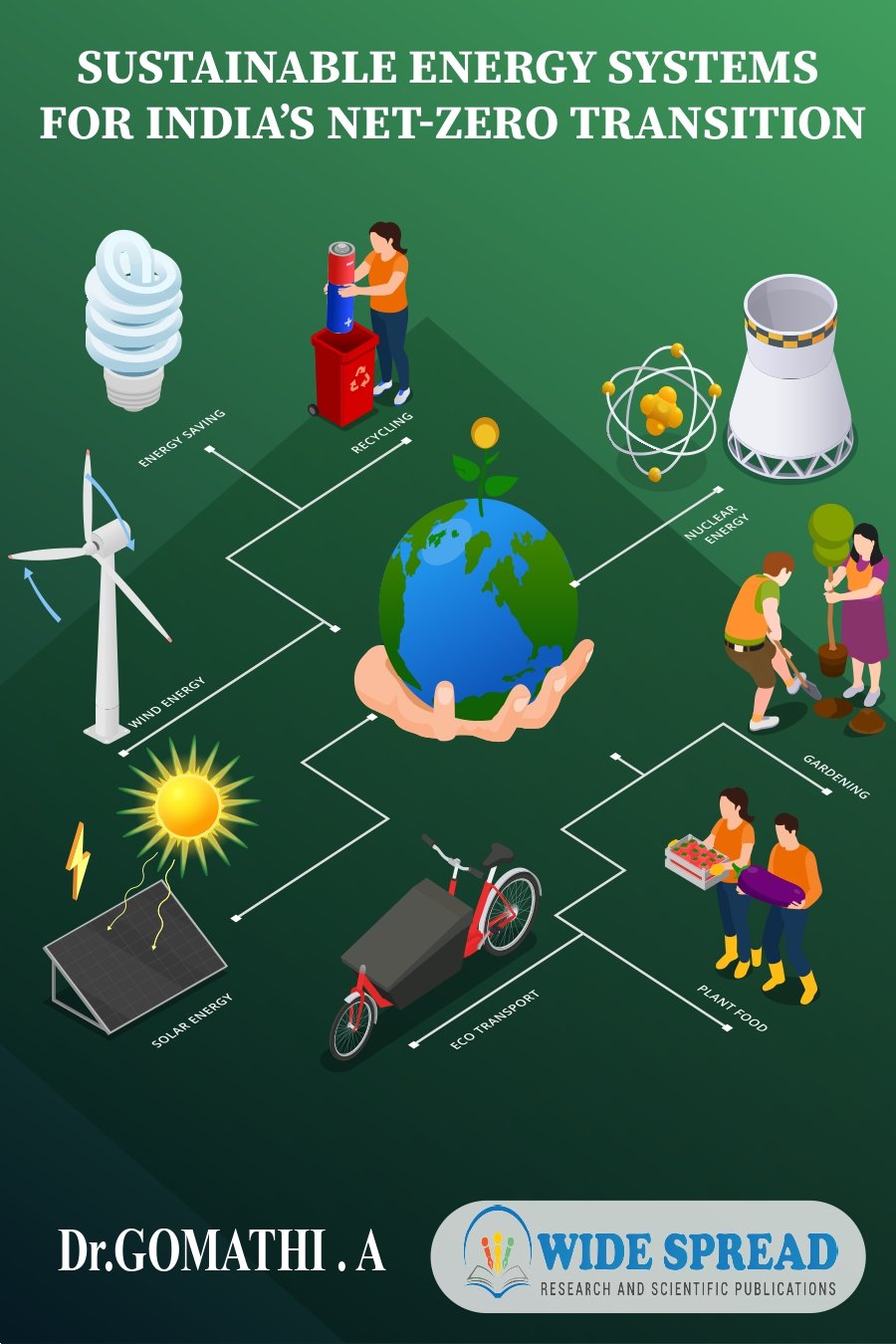

Sustainable Energy Systems for India’s Net-Zero Transition
Original price was: $650.00.$600.00Current price is: $600.00.
Dr.Gomathi A
Description
1.1. INDIA’S CURRENT ENERGY LANDSCAPE AND EMISSIONS PROFILE
Energy demand in India is increasing at a significant pace, which has substantial effects on the global energy market. The Indian government has made significant strides in enhancing access to electricity and clean cooking solutions, while also undertaking various energy market reforms and incorporating a substantial share of renewable energy sources into the national grid. With a population of 1.36 billion and a rapidly expanding economy, India’s energy requirements are rising as urbanization progresses and the manufacturing sector evolves. This escalating demand is supported by multiple energy sources, although coal is expected to continue being the predominant supply source. Additionally, India is advancing its institutional framework to attract the necessary investments to meet this growing energy demand.
The security of electricity supply has been bolstered through the establishment of a unified national power system alongside significant investments in clean energy initiatives. Currently, efforts are underway to enhance the integration of variable renewable energy into the overall energy portfolio. Between 2016 and 2018, the contributions from solar photovoltaic (PV) and wind power in electricity generation doubled from 4% to 8%. Improvements in energy efficiency have led to avoiding an extra 15% of energy demand and reducing carbon dioxide emissions by 300 million tons over the span from 2000 to 2018.
Moreover, India has placed priority on ensuring access to electricity and clean cooking options. The advancements in these areas have been noteworthy: since 2000, approximately 700 million individuals have gained access to electricity, along with an additional 80 million liquefied petroleum gas (LPG) connections for clean cooking purposes. The Government of India remains committed to delivering secure, affordable,and sustainable energy solutions while striving towards ambitious renewable energy goals and working towards minimizing local air pollution.
Solar Energy Companies in India
India is anticipated to experience the most significant increase in energy demand compared to any other nation in the upcoming decades, primarily due to its substantial population and growth potential. To sustainably address this rising demand, a majority of the additional energy needs must be fulfilled through low-carbon and renewable sources. The country’s aim for net-zero emissions by 2070 and its target of achieving 50% renewable electricity by 2030 represent a key milestone in global climate efforts.
As of FY25, India retains its position as the fourth-largest country worldwide in terms of wind power capacity, solar power capacity, and total installed renewable energy capacity, consistent with its status from FY24. It is also recognized as the fastest- growing market for renewable electricity, with projections indicating that new capacity additions could double by 2026. India has officially overtaken Japan to become the world’s third-largest producer of solar energy; recent data from the International Renewable Energy Agency (IRENA) reveals that India generated 108,494 GWh of solar power, surpassing Japan’s output of 96,459 GWh.
With increased governmental support and improved economic conditions, the renewable energy sector has become appealing to investors. As India aims to independently satisfy its projected energy demand of 15,820 TWh by 2040, renewable energy is expected to play a crucial role.
Energy Resources of India
Data regarding India’s energy resources can be categorized into primary or secondary types (i.e., naturally occurring or requiring processing) and renewable or non-renewable sources. The key energy resources in India encompass:
Coal: This resource is the predominant source of emissions within India’s energy sector. The nation possesses significant coal reserves utilized for electricity generation, although it imports higher-grade coking coal for steel production.
Crude Oil and Petroleum Products: India relies heavily on imports of crude oil to manufacture petroleum products domestically. These products are a major contributor to emissions, especially from the transportation sector. Transitioning this sector to electrification would decrease the demand for petroleum products and subsequently reduce the need for crude oil imports.
Renewable Energy Sources: Solar, wind, and hydroelectric power are rapidly expanding within India’s energy portfolio and play a crucial role in facilitating the country’s decarbonization initiatives.
Natural Gas: Although India consumes relatively small quantities of natural gas, it holds significance for non-energy applications, such as serving as feedstock in fertilizer production and various manufacturing industries.
Related products
-
- Sale!
- Books
ARTIFICIAL INTELLIGENCE : A MODERN APPROACH
- Original price was: $650.00.$600.00Current price is: $600.00.
- Add to cart
-
- Sale!
- Books
APPLIED BIOPHARMACEUTICS AND PHARMACOKINETICS
- Original price was: $650.00.$600.00Current price is: $600.00.
- Add to cart
-
- Sale!
- Books
ROAD MAP TO PYTHON
- Original price was: $650.00.$630.00Current price is: $630.00.
- Add to cart





Reviews
There are no reviews yet.