

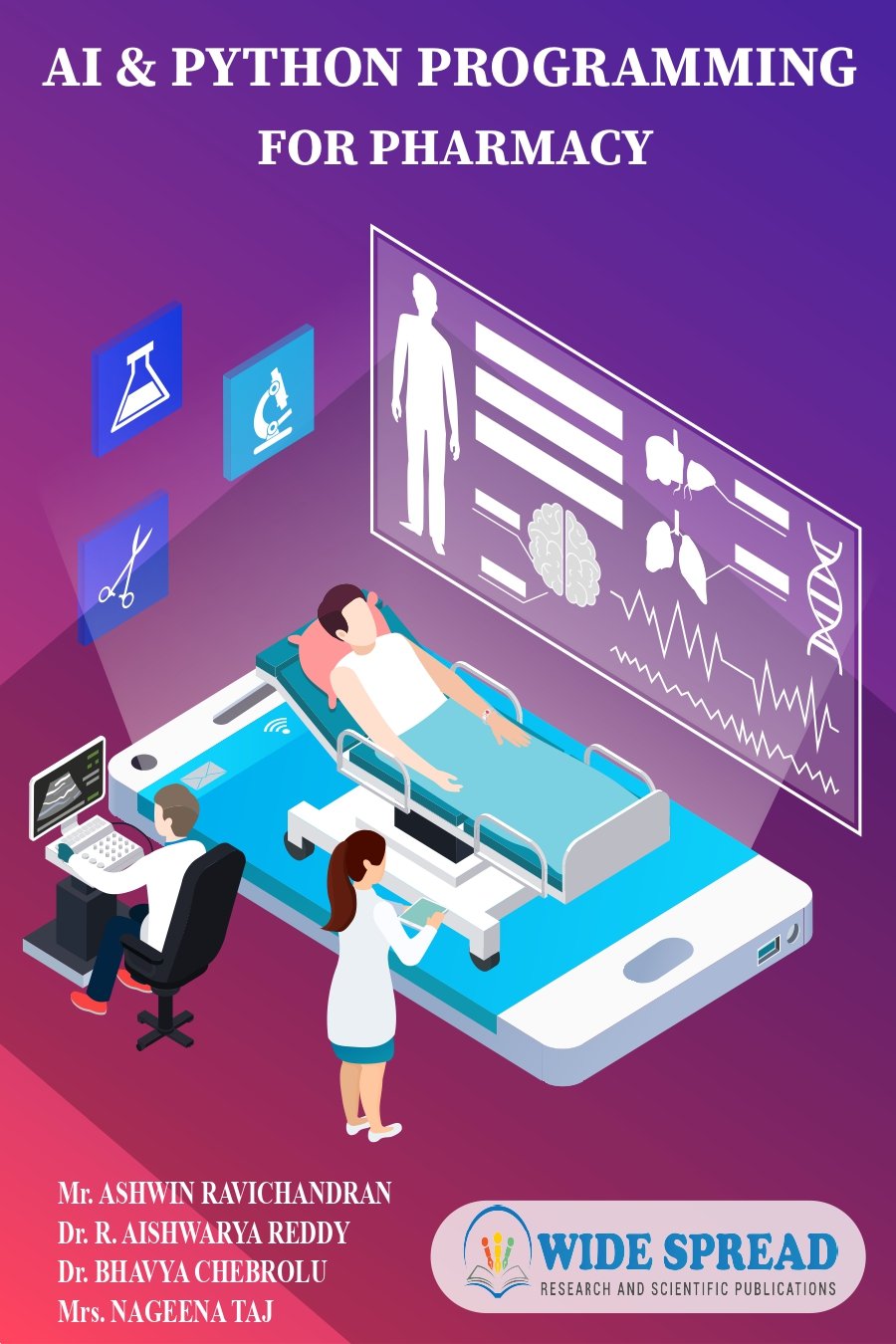

AI & PYTHON PROGRAMMING FOR PHARMACY
Original price was: $650.00.$600.00Current price is: $600.00.
Ashwin Ravichandran , Dr. R. Aishwarya Reddy , Dr. Bhavya Chebrolu , Mrs. Nageena Taj
Description
Artificial Intelligence (AI) has evolved from a futuristic idea often depicted in science fiction to a powerful force that is transforming numerous sectors, economies, and everyday experiences. With innovations like voice-activated virtual assistants and the algorithms behind autonomous vehicles, AI is fundamentally altering how we engage with technology. This article provides a thorough examination of the core principles of AI, its diverse applications, and the historical backdrop that has influenced its advancement. The aim is to offer a detailed overview of AI’s present condition, its developmental path, and possible future trajectories.
A Brief Overview of Milestones in AI History
One effective method to encapsulate significant achievements in the history of artificial intelligence (AI) is by highlighting the recipients of the Turing Award: Marvin Minsky (1969) and John McCarthy (1971), who laid the groundwork for the field through their work on representation and reasoning; Allen Newell and Herbert Simon (1975), recognized for their contributions to symbolic models relevant to problem-solving and human cognition; Ed Feigenbaum and Raj Reddy (1994) for pioneering expert systems that encapsulate human knowledge to address practical challenges; Judea Pearl (2011), who advanced probabilistic reasoning techniques that manage uncertainty systematically; and lastly, Yoshua Bengio, Geoffrey Hinton, and Yann LeCun (2019), credited with establishing ―deep learning‖ (multilayer neural networks) as a vital component of contemporary computing. The following section will delve deeper into each phase of AI’s evolution.
The Birth of Artificial Intelligence (1943–1956)
The initial work recognized today as foundational to AI was conducted by Warren McCulloch and Walter Pitts in 1943. Drawing inspiration from Nicolas Rashevsky’s mathematical modeling efforts, they integrated three primary influences: an understanding of neuronal physiology and function; a formal evaluation of propositional logic from Russell and Whitehead; along with Turing’s computational theory. They introduced a model for artificial neurons characterized as either ―on‖ or ―off,‖ with activation occurring when adequately stimulated by neighboring neurons. Each neuron’s state was viewed as ―factually equivalent to a proposition that indicated its appropriate stimulus.‖ They demonstrated that any computable function could be executed by interconnected neural networks, with all logical operations (AND, OR, NOT, etc.) being realizable through basic network configurations. Furthermore, McCulloch and Pitts posited that appropriately defined networks had the capacity for learning. In 1949, Donald Hebb presented a straightforward rule for adjusting connection strengths among neurons, known today as Hebbian learning a concept that continues to be influential. In 1950, two Harvard undergraduates, Marvin Minsky and Dean Edmonds, constructed the inaugural neural network computer.
Initial Enthusiasm and High Hopes (1952–1969)
During the 1950s, many intellectuals were inclined to assert that ―a machine can never do X.‖ In response, AI researchers sequentially demonstrated capabilities across various domains once deemed exclusive to human intelligence such as games, puzzles, mathematics, and IQ assessments. John McCarthy referred to this time as the “Look, Ma, no hands!” era. Following their earlier success with Logic Theorist (LT), Newell and Simon created the General Problem Solver (GPS). Unlike LT, GPS was specifically designed from its inception to replicate human problem-solving strategies. Within its limited range of applicable puzzles, it became evident that GPS approached subgoals and possible actions similarly to how humans would tackle these issues—marking it likely as the first program embodying a “thinking humanly” approach. The accomplishments of GPS and other subsequent programs modeling cognitive processes led Newell and Simon in 1976 to propose the renowned physical symbol system hypothesis: asserting that “a physical symbol system has the necessary and sufficient means for general intelligent action.” Essentially, they argued that any entity exhibiting intelligence be it human or machine must function by manipulating data structures made up of symbols. This hypothesis has faced numerous challenges over time . At IBM during this period, Nathaniel Rochester along with his team developed some of the earliest AI programs.
Related products
-
- Sale!
- Books
BLOCKCHAIN SOLUTION FOR CYBERSECURITY AND PRIVACY
- Original price was: $450.00.$430.00Current price is: $430.00.
- Add to cart
-
- Sale!
- Books
Convergence of Artificial Intelligence and Biotechnology in Healthcare Systems
- Original price was: $850.00.$800.00Current price is: $800.00.
- Add to cart
-
- Sale!
- Books
Biography of Professor Ramdeo Mishra, The Father of Indian Ecology
- Original price was: $650.00.$600.00Current price is: $600.00.
- Add to cart





Reviews
There are no reviews yet.