


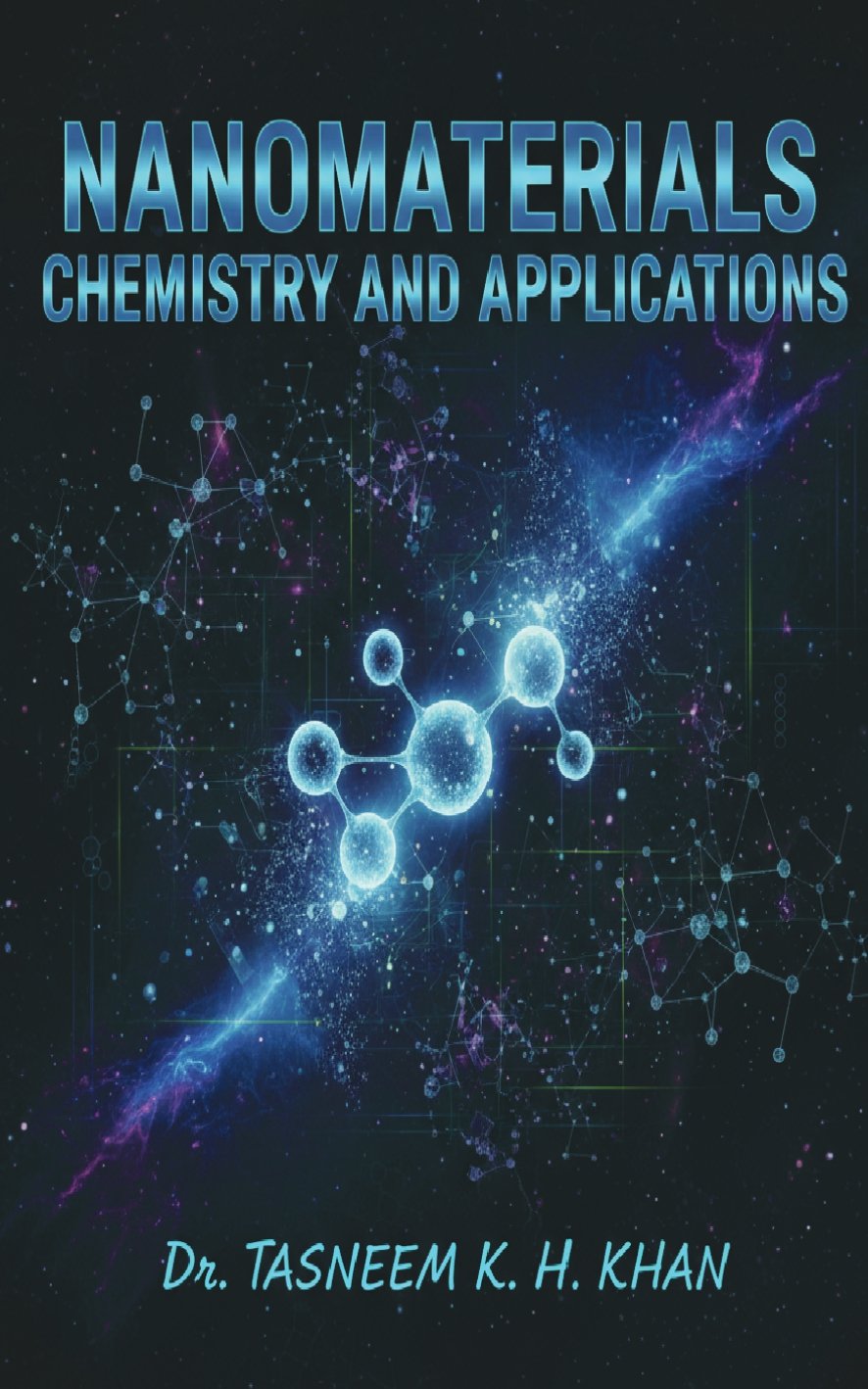
Nanomaterials : Chemistry and Applications
Original price was: $650.00.$630.00Current price is: $630.00.
Dr. Tasneem K. H. Khan
Description
Nanomaterials are materials with at least one dimension on the nanometric scale, ranging in size from 1 to 100 nm. These compounds are undetectable to the human eye. Nanomaterials are studied using materials science and nanotechnology techniques. In contrast to their molecular activity, these materials have well-defined optical, electrical, mechanical, and quantum-mechanical properties at this size. Nanomaterials can be defined as materials that contain nano-objects or nanostructures. Nano-objects are separate bits of material, as opposed to nanostructured materials, which have a nanoscale internal or external structure. Nanomaterials can be created intentionally, inadvertently, or naturally. Nanomaterials are now being produced and exploited as commodities as a result of technological discoveries .
Nanomaterials are employed in a variety of industries, including air purification and environmental preservation, as well as healthcare and cosmetics, due to their ability to be created in a specific way to perform a particular function. For example, nanoparticles are widely used in the healthcare industry, with medicine delivery being one of the most common applications. One example of this method is the production of nanoparticles to aid in the transportation of chemotherapy treatments directly to malignant growths, as well as the delivery of medications to damaged arteries in order to combat cardiovascular disease. Another application for carbon nanotubes is the development of bacteria sensors by mixing antibodies with nanotubes.
Carbon nanotubes can be used in aerospace to alter the geometry of aircraft wings. The composite structure of the nanotubes is used to induce bending in response to an electric voltage. Other environmental preservation strategies also make use of nanomaterials, specifically nanowires. The use of zinc oxide nanowires in flexible solar panels and the treatment of tainted water are two applications currently being researched.
Properties of nanomaterials
When nanoscale materials decompose, they exhibit different changes in characteristics. Quantum size effects cause changes in the electrical characteristics of materials as they progress from the molecular to the nanoscale. Materials’ mechanical, thermal, and catalytic properties can alter when the surface area-to-volume ratio increases at the nanoscale. Many insulator materials behave like conductors at nanoscale. The same is true at nanoscale dimensions, where we can observe a range of exciting quantum and surface phenomena.
Nanomaterials’ physical and chemical features include size, shape, chemical composition, crystal structure, stability, surface area, and surface energy, among others. As the surface-to-volume ratio of nanomaterials grows, their surfaces become more reactive with one another and other systems. The pharmacological effects of nanomaterials are strongly determined by their size. Nanomaterials’ crystal structures can alter when they contact with water or other dispersion media. Nanomaterials’ aggregation state is determined by their size, composition, and surface charge. The magnetic, physicochemical, and psychokinetic properties of these materials are influenced by surface coatings. The interaction of particles at the nanoscale is caused by strong polar or covalent bonds, as well as van der Waals forces. Polyelectrolytes can be used to alter the surface characteristics of nanomaterials and their interactions with other substances and environments.
Related products
-
- Sale!
- Books
BLOCKCHAIN SOLUTION FOR CYBERSECURITY AND PRIVACY
- Original price was: $450.00.$430.00Current price is: $430.00.
- Add to cart
-
- Sale!
- Books
APPLIED BIOPHARMACEUTICS AND PHARMACOKINETICS
- Original price was: $650.00.$600.00Current price is: $600.00.
- Add to cart
-
- Sale!
- Books
CORPORATE ACCOUNTING: CONCEPTS AND APPLICATIONS
- Original price was: $650.00.$630.00Current price is: $630.00.
- Add to cart



Reviews
There are no reviews yet.