
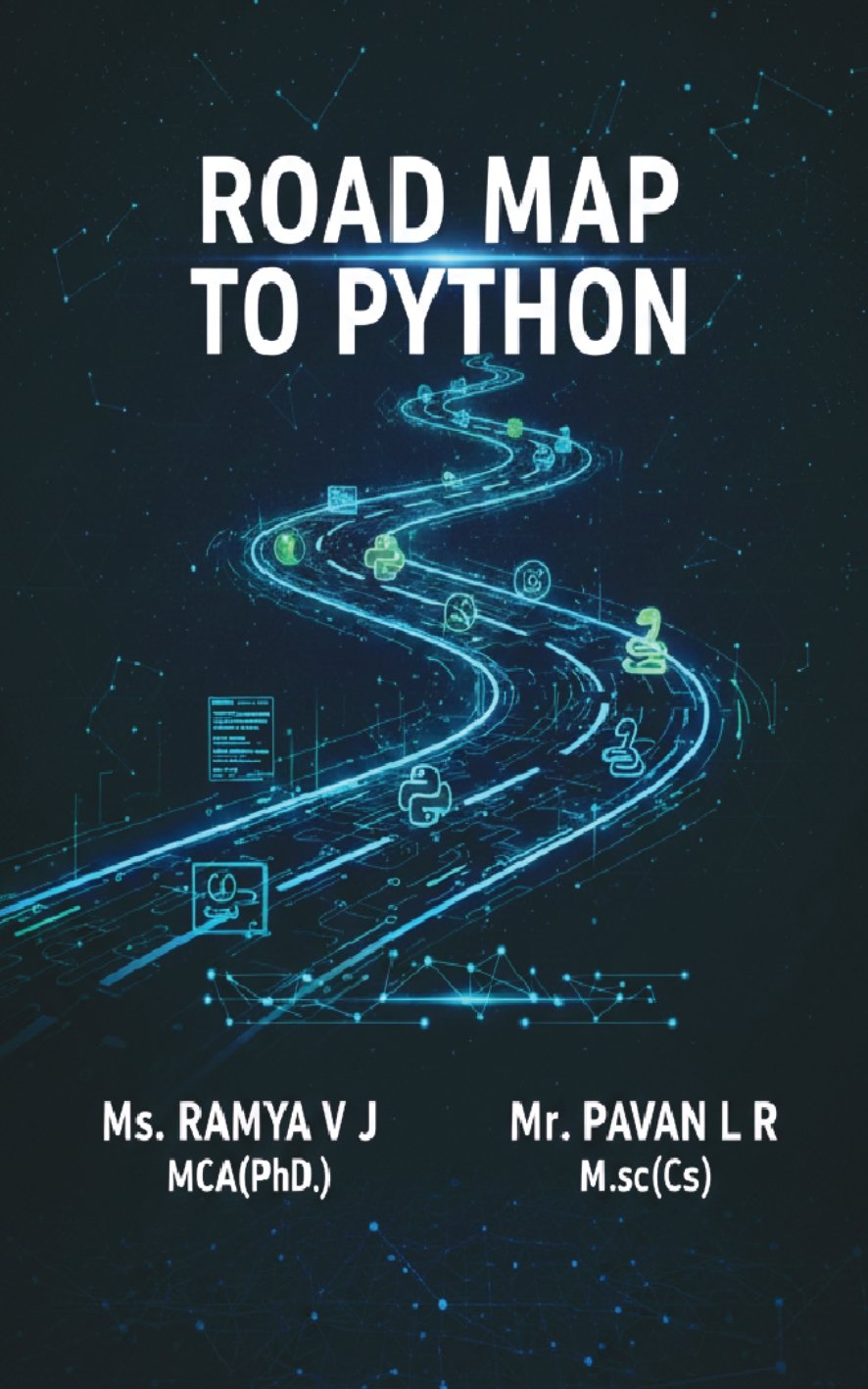
ROAD MAP TO PYTHON
Original price was: $650.00.$630.00Current price is: $630.00.
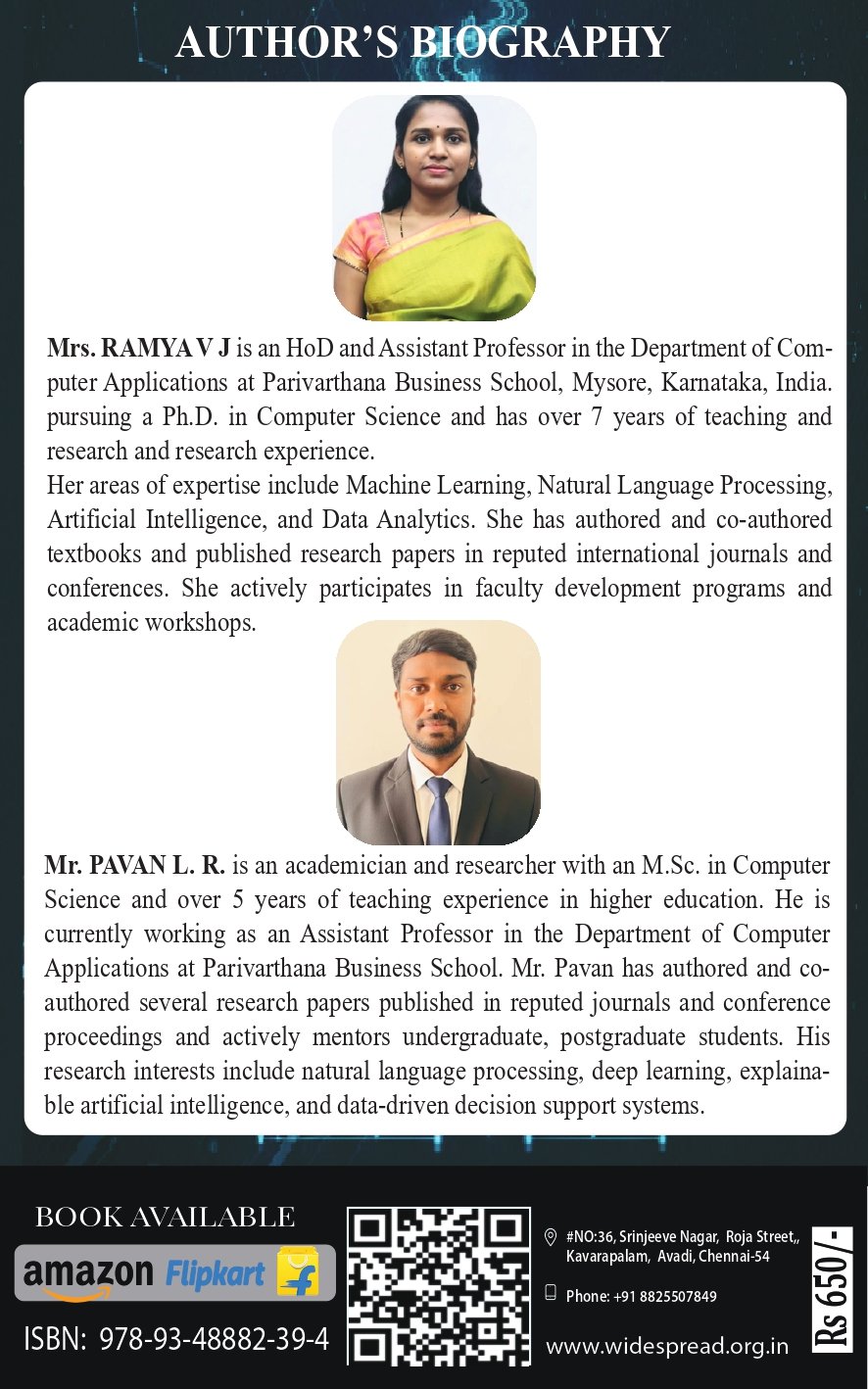
Ms. RAMYA V J MCA(PhD,) ,Mr. PAVAN L R M.sc (Cs)
Description
Python is an interpreted (bytecode-compiled) dynamic language. The source code contains no type declarations for variables, parameters, functions, or methods. As a result, the code becomes more concise and adaptable, but the source code’s compile- time type checking is lost. At runtime, Python keeps track of every value’s type and flags any code that doesn’t make sense.
Running the Python interpreter and typing code directly into it is a great method to see how Python programming functions. “What happens if I add an int to a list?” is a common query. It’s quick and probably the easiest method to see what occurs to simply type it into the Python interpreter.
One well-liked programming language is Python. Guido van Rossum developed it, and it was published in 1991.
It is used for :
Server-side Web development, Software development, Mathematics,Scripting systems
Python Syntax compared to other programming languages
Python was created with readability in mind, and it shares some characteristics with the English language while also drawing inspiration from mathematics.
Unlike other programming languages, which frequently use semicolons or parentheses to finish an operation, Python employs new lines.
Python uses whitespace and indentation to define scope, including the scope of loops, functions, and classes. Curly brackets are frequently used for this purpose in other computer languages.
Python is compatible with a variety of operating systems, including Windows, Mac, Linux, and Raspberry Pi.
Like the English language, Python has a straightforward syntax.
Compared to certain other programming languages, Python’s syntax enables programmers to construct programs with less lines.
Because Python uses an interpreter system, code can be run as soon as it is written. Prototyping can therefore be completed relatively quickly.
Related products
-
- Sale!
- Books
CORPORATE ACCOUNTING: CONCEPTS AND APPLICATIONS
- Original price was: $650.00.$630.00Current price is: $630.00.
- Add to cart
-
- Sale!
- Books
Convergence of Artificial Intelligence and Biotechnology in Healthcare Systems
- Original price was: $850.00.$800.00Current price is: $800.00.
- Add to cart
-
- Sale!
- Books
APPLIED BIOPHARMACEUTICS AND PHARMACOKINETICS
- Original price was: $650.00.$600.00Current price is: $600.00.
- Add to cart


Reviews
There are no reviews yet.